

If you’re deciding between CapCut and After Effects, you’re not really choosing between two “video editors.” You’re choosing between fast social editing and serious motion graphics.
CapCut vs After Effects isn’t a “which editor has more features” fight. It’s a workflow fight.
CapCut is made to cut clips quickly, add captions, and push out TikTok, Reels, and Shorts without a headache.
After Effects is made to animate text, build effects, and create motion work that looks custom, not templated.
This post breaks it down using the same criteria every time: pricing, ease, templates, captions, export quality, watermark, and whether it makes sense for your device and workflow.
TL;DR Verdict
Pick CapCut if:
- You want fast edits for TikTok/Reels/Shorts with templates + effects
- You rely on quick auto captions and simple subtitle styling
- You want the fastest “idea → post” workflow
Pick After Effects if:
- You want motion graphics, animated text, and custom visual effects
- You need precise control (keyframes, masking, tracking, compositing)
- You’re making intros, ads, and branded visuals that shouldn’t look templated
Biggest difference: CapCut is trend/template-driven; After Effects is custom motion design.
Best for TikTok/Reels: CapCut
Best for clean long-form edits: CapCut (AE is for motion pieces, not full edits)
Best for promo work: After Effects
Table of Contents
- CapCut vs After Effects at a Glance
- Pricing and Free Plan
- Learning Curve: Which Feels Easier in 10 minutes?
- Free vs Paid: What Actually Gets Locked?
- Feature Battle: CapCut vs After Effects (Real Creator Categories)
- Best For: Pick the Tool That Matches How You Work
- Tips to Get the Most Out of Either Tool
- CapCut vs After Effects FAQs
- Final Verdict: CapCut vs After Effects
- Official Resources
CapCut vs After Effects at a Glance
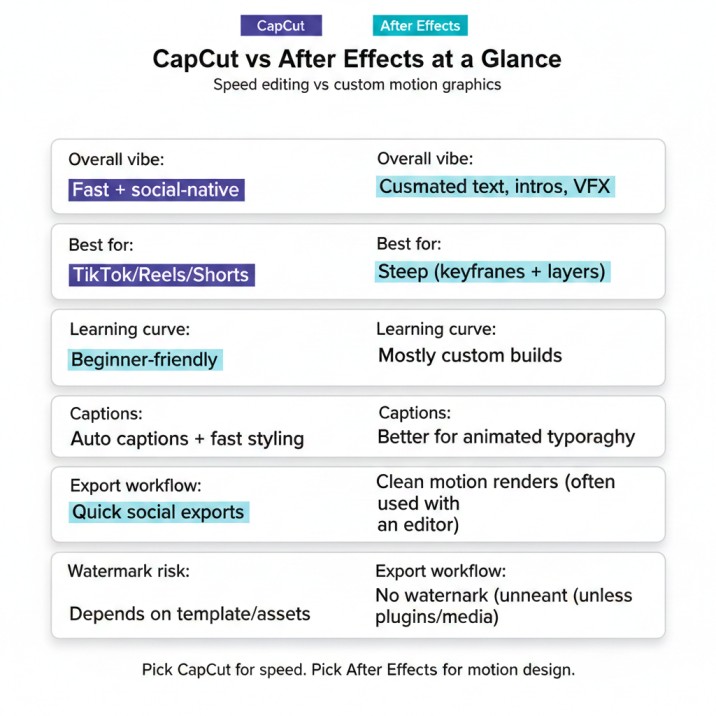
- Price vibe: CapCut is free-first with optional upgrades; After Effects is a paid subscription built for motion graphics
- Platforms: CapCut is strongest on mobile (with desktop options depending on region); After Effects is desktop-only (Windows/Mac)
- Learning curve: CapCut is beginner-friendly; After Effects takes time and practice
- Templates: CapCut is template-heavy for short-form; After Effects is mostly custom work, not templates
- Captions: CapCut is quick for captions; After Effects can do animated text, but it’s slower for basic subtitle workflows
- Export and quality: CapCut is fast for social exports; After Effects is best when you need custom motion and high-end visuals
- Best use case: CapCut for quick TikTok/Reels/Shorts edits; After Effects for motion graphics, animated text, and visual effects
Comparing more options? This CapCut comparisons hub lays them all out.
Pricing and Free Plan
CapCut pricing
- CapCut Free: $0
- CapCut Pro (monthly): $19.99/month
- CapCut Pro (annual): $179.99/year (about $14.99/month when averaged)
Note: CapCut also offers other options (like a Standard/mobile-focused plan and a Teams plan). See the full breakdown here: CapCut pricing guide.
After Effects pricing
- After Effects (annual, billed monthly): $22.99/month
- After Effects (month-to-month): $34.49/month
- After Effects (annual, prepaid): $263.88/year (about $21.99/month when averaged)
Which is better for value?
If you want the lowest-cost way to edit and post consistently, CapCut is the better value because you can do a lot for free and only pay if you want Pro features. If you specifically need motion graphics and visual effects, After Effects is the better value because it’s built for custom animation and compositing that CapCut simply isn’t designed to replace.
Learning Curve: Which Feels Easier in 10 minutes?
If you’re brand new, CapCut usually feels easier right away because templates and presets do a lot of the heavy lifting. You can trim clips, drop in captions, add effects, and end up with something that looks “done” fast.
After Effects is the opposite. It’s not built for quick wins. You’re dealing with compositions, layers, keyframes, and settings that feel technical at first. Even simple text animation takes a few steps before it looks right.
So the real question isn’t “which one is easier?” It’s this:
Do you want a tool that helps you finish faster (CapCut), or a tool that rewards you once you learn it (After Effects)?
Winner for beginners: CapCut
Winner for long-term control: After Effects
Free vs Paid: What Actually Gets Locked?
Both tools can technically be used without paying, but they lock different things — and that changes how “free” feels once you’re editing regularly.
The question isn’t “which one is free?” It’s which one stays usable for your workflow without interrupting you mid-edit?
CapCut pricing (Free vs Paid)
CapCut Free is one of the most usable free setups for short-form creators. You can finish real edits without paying, but you’ll see Pro labels on certain tools and assets.
What CapCut Free usually includes:
- Basic editing (trim, split, speed, transitions, filters)
- Auto captions (some styles/features may be limited)
- Lots of effects/templates (premium ones show “Pro”)
- Exports that are often clean (watch template/asset restrictions)
CapCut pushes upgrades when you tap premium templates, effects, fonts, stock assets, or newer AI-style tools.
After Effects pricing (Paid)
After Effects isn’t “free-first.” It’s a paid tool, and it’s priced like pro software.
What you’re paying for:
- Keyframe animation + motion graphics tools
- Compositing, masking, tracking, effects
- A full motion workflow meant for custom work (not templates)
You can use a trial, but long-term it’s a subscription tool.
Which feels worth paying for?
If you never pay, CapCut is the only one that stays realistically usable for actual editing and posting.
After Effects is worth paying for when your work depends on custom motion graphics — titles, intros, kinetic text, branded visuals — and you want control you can’t get from templates.
Quick takeaway: CapCut is “free-to-post.” After Effects is “pay-to-design motion.”
Feature Battle: CapCut vs After Effects (Real Creator Categories)
Instead of listing every button, this is about the moments where one tool actually feels better while you’re working.
Templates and trending effects
This is CapCut’s home turf.
CapCut: Packed with templates, trending effects, text animations, and transitions. Pick a style, swap clips, post fast.
After Effects: Not template-first. You can use presets, but most “looks” are built, not picked.
Winner: CapCut (especially for trend-driven short-form)
Manual control and “real” precision
This is where After Effects separates itself.
CapCut: You get control, but it’s still an editor built for speed.
After Effects: Total control over motion. Keyframes, easing, masks, tracking, compositing — you can build exactly what you see in your head.
Winner: After Effects (for motion control)
Captions and text
CapCut: Faster for auto captions + subtitle styling. Built for social text.
After Effects: Better for animated typography (kinetic text, custom title sequences), but slower for basic subtitles.
Winner: CapCut for speed; After Effects for animated text
Visual polish and “custom look”
CapCut: Quick polish, but many standout styles can be tied to premium assets/templates.
After Effects: Designed for clean, custom motion work that doesn’t look templated.
Winner: After Effects (for custom brand visuals)
Export workflow
CapCut: Exports fast for social formats (9:16, 1:1, 16:9) with minimal steps.
After Effects: Exports can be extremely clean, but it’s often used to render motion pieces that get dropped into an editor for the final video.
Winner: CapCut for everyday exports; After Effects for motion renders
Watermark behavior (what to expect)
CapCut: Often clean, but watermark/limits can show up depending on the template/asset used.
After Effects: No watermark from Adobe. Watermarks only happen if you use trial plugins or watermarked media.
Winner: After Effects (less watermark stress)
Speed vs focus
CapCut: Faster when you want the app to do more for you.
After Effects: Slower, but unmatched when you want control and a signature look.
Winner: CapCut for speed; After Effects for control
Best For: Pick the Tool That Matches How You Work
Most people don’t pick the wrong tool because it’s “bad.” They pick the wrong tool because it doesn’t match how they actually edit.
Best for TikTok, Reels, and Shorts
CapCut is usually the easier choice for short-form because it’s built around speed: templates, effects, and captions that look social-ready fast.
After Effects can help short-form too, but mostly when you want custom motion elements (animated titles, kinetic text, effects) — not when you’re trying to crank out daily edits.
Best for YouTube videos (and long-form)
CapCut can handle basic YouTube editing, but After Effects isn’t really a long-form editor. The common workflow is: build motion pieces in After Effects, then assemble the full video in a timeline editor.
If your YouTube videos need animated intros, lower thirds, or motion-heavy segments, After Effects is the add-on tool — not the main editor.
Best for beginners
CapCut usually feels easier in the first 10 minutes because it gives you fast wins with templates and automation.
After Effects makes more sense after you accept the learning curve and actually want motion design control.
Best for creators who want custom visuals
If your goal is brand-level motion graphics (clean animated titles, consistent style, effects that don’t look templated), After Effects wins.
Best for speed and volume
If you post often and want the fastest path from idea to upload, CapCut saves time because it removes steps.
Quick takeaway: CapCut wins when speed, trends, captions, and volume matter. After Effects wins when custom motion, polish, and control matter more.
Common Scenarios (Quick Picks)
Pick the line that sounds like you. The winner is on the right.
Tips to Get the Most Out of Either Tool
A fast workflow for CapCut
Start with a template only to get structure, then customize it.
Swap your clips, clean up the captions, and remove anything that feels overdone. You keep the speed without looking copy-pasted.
A clean workflow for After Effects
Build in layers.
Block the motion first (timing + keyframes), then polish (easing), then add effects last. After Effects rewards clean structure more than “stacking stuff.”
Export test checklist
- Export one short test clip before finishing the full project
- Watch it on your phone (full screen)
- Check text sharpness, audio balance, and pacing
That tiny test saves you from posting something that looks different after upload.
CapCut vs After Effects FAQs
Is CapCut better than After Effects?
CapCut is better for fast TikTok, Instagram Reels, and YouTube Shorts edits because it has templates, effects, captions, and a quicker social-first workflow. After Effects is better for motion graphics, animated text, compositing, tracking, masking, and custom visual effects.
Can CapCut replace After Effects?
No, not for serious motion graphics work. CapCut can create good-looking social videos quickly, but After Effects gives you far deeper control over keyframes, layers, masks, tracking, compositing, and custom animation.
Is After Effects good for editing full videos?
After Effects is not the best tool for editing full videos from start to finish. It is better for creating motion pieces such as intros, lower thirds, animated titles, kinetic text, and effects that you export and use inside a main video editor.
Which is better for captions and subtitles?
CapCut is usually better for fast captions and subtitles because it has quick auto-caption tools and social-style subtitle formatting. After Effects is better for custom animated typography, but it is slower and more manual for basic subtitle workflows.
Does CapCut add a watermark?
CapCut basic exports are often watermark-free, but restrictions can appear if you use locked templates, Pro effects, premium assets, or certain export options. Always check the export screen before finishing your video.
Does After Effects add a watermark?
No. After Effects does not add an Adobe watermark to normal exports. Watermarks usually come from third-party trial plugins, stock assets, or media that already includes a watermark.
Which is easier for beginners, CapCut or After Effects?
CapCut is much easier for beginners because templates, presets, captions, and effects help you finish videos quickly. After Effects has a steeper learning curve because it uses compositions, layers, keyframes, masks, and animation controls.
Should I use CapCut and After Effects together?
Yes, that can be a strong workflow. Use CapCut to edit the full video quickly, then use After Effects only for custom motion graphics, animated titles, intros, kinetic text, or branded visual effects that need more control.
Final Verdict: CapCut vs After Effects
Choose CapCut if your priority is fast, trend-ready content. It’s built to help you finish edits quickly, especially for short-form platforms.
Choose After Effects if your priority is custom motion graphics. It’s slower, but it gives you the control to build animated text, branded visuals, and effects that don’t look templated.
Safest choice for most creators: start with CapCut for editing, and use After Effects only when you need motion graphics pieces (titles, intros, kinetic text) that level up the final video.
