
How to Improve Video Quality on CapCut in 2026 (Mobile + Desktop)


Ever filmed a great clip… then watched it back and it looked grainy, dark, or kind of blurry? That feeling is the worst, especially when you know the moment was good.
So let’s answer the big question: can you improve video quality on CapCut?
Yes, you can, as long as you use the right tools in the right order. CapCut won’t magically turn a totally out-of-focus video into real 4K detail, but it can make your footage look cleaner, sharper, brighter, and way more watchable.
I’ll show you exactly what to tap and what to adjust on both mobile and desktop, plus the export settings that stop your video from looking worse after you save it.
What “Better Video Quality” Means (So You Know What to Fix)
Before jumping into CapCut’s tools, it helps to understand what “better quality” really means in video editing terms.
Good video quality isn’t just about resolution (1080p, 2K, 4K). It’s a combination of several things:
- Sharpness: How clear the details look.
- Brightness and contrast: Whether the lighting feels balanced or flat.
- Color grading: The mood and tone created by color adjustments.
- Stability: Whether the footage is smooth or shaky.
- Noise reduction: How clean the image looks, especially in dark scenes.
CapCut has features that target each of these areas — some automatic, others manual — that can make your footage look significantly better even if it wasn’t shot perfectly.
Quick Answer: Can i Improve Video Quality on CapCut?
Yes. You can improve video quality on CapCut by fixing lighting, adding controlled sharpness, reducing grain, stabilizing shaky footage, and exporting with the right bitrate so your video doesn’t get crushed.
Here’s what CapCut can help with:
- Improve clarity with sharpness + enhance tools
- Fix dull or dark clips using exposure/brightness/contrast
- Make colors look more natural using basic color correction
- Smooth shaky footage using stabilization
- Make exports look cleaner with higher resolution + higher bitrate
But here’s the limit: CapCut can’t bring back detail that was never captured. If the footage is out of focus, it can only help so much.
Fast checklist: Improve Video Quality in CapCut in 5 minutes
If you only do five things, do these:
- Fix lighting first (Exposure, Brightness, Contrast)
- Reduce grain/noise (only if the clip is noisy)
- Add a small amount of sharpness
- Use AI Enhance/Upscale only when needed
- Export in 1080p (or 4K if your original is 4K) with high bitrate
That order matters. If you sharpen before fixing noise, you can make the grain look worse.
Improving video quality is great, but what if you want to level up your entire editing game? Read our full guide on CapCut Features and Capabilities and learn all the essential tools that take your videos from good to great.
Use CapCut AI tools to upscale and remove noise (when your footage is soft or grainy)
If your video looks a little blurry, muddy, or noisy, CapCut’s AI tools can help. This is best for clips that were filmed in low light, older videos, or footage that got compressed (like something sent on WhatsApp).
1) AI Upscale (to improve clarity on low-res clips)
AI Upscale can make 480p or 720p footage look sharper on modern screens. It won’t create perfect “real 4K,” but it can improve edges and reduce that fuzzy look.
- Use it when faces look soft or details look smeared.
- Keep sharpening low after upscaling, or the video can look crunchy.
2) AI Denoise / Reduce image noise (to remove grain)
If your video was shot indoors or at night, the grain is usually the real problem, not the resolution. Denoise smooths out that messy texture while keeping the image cleaner.
- Use it before adding Sharpness.
- Don’t push it too hard, or skin can start looking waxy.
Best order: Denoise first → fix lighting → slight sharpness → export with high bitrate.
Before you edit: 3 things that decide how good CapCut can make your video look
CapCut can improve video quality, but your starting clip sets the ceiling. If you know what you’re working with, you’ll get better results faster.
1) Resolution (how much detail you actually captured)
If the original clip is 720p, exporting in 4K won’t magically add real detail. You can still make it look cleaner, but you can’t invent missing pixels.
2) Lighting (the real secret)
Bad lighting creates noise and blur. Fixing exposure and contrast often makes a bigger difference than sharpening.
3) Compression damage (the “WhatsApp effect”)
If the clip was sent through messaging apps, it may already be crushed. AI Upscale + Denoise can help, but it won’t fully restore what compression removed.
How to Increase Video Quality in CapCut (Step-by-Step for Desktop)

The desktop version of CapCut gives you the most control and precision. Here’s how to use it to make your video quality noticeably better.
Step 1: Create a New Project
As usual, open CapCut on your computer and click Create Project. Import your video file and drag it to the timeline.
Step 2: Adjust Resolution Settings
Before editing, check your project settings.
Go to the Export settings or click the resolution icon on the top bar ( see image below).

- Choose 1080p or 4K (if your hardware supports it).
- Set FPS (frames per second) to match your source (30 or 60 for smooth motion).
Step 3: Use the “Enhance” Feature
Select your clip in the timeline. In the right-hand menu, look for Enhance (or sometimes called “AI Enhance”). You will have to scroll down to see it.
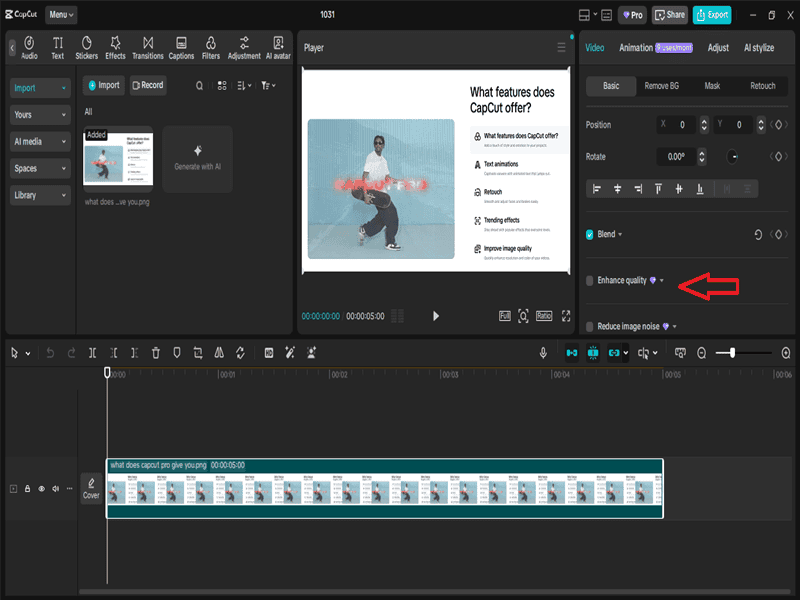
- Toggle it on.
- Adjust the strength slider to a moderate setting usually gives the best results without over-sharpening.
Step 4: Fine-Tune Brightness and Contrast
Click Adjust in the toolbar and tweak these settings:

- Brightness: brighten dark footage slightly.
- Contrast: make details pop.
- Saturation: bring color to life, but don’t overdo it.
- Sharpen: adds clarity, but keep it under 50% to avoid noise.
Step 5: Apply Filters or LUTs
Under Filters or Color, apply a preset or custom LUT to enhance color tone. Choose filters that match the mood cinematic, warm, cool, or natural.
Step 6: Stabilize Shaky Footage
If your clip looks wobbly, select it and click Stabilize. Adjust the intensity to smooth out camera movement.
Step 7: Preview and Export
Play back the video to check your results. When exporting, choose High Quality mode and set the bitrate to 15 Mbps or higher for sharp detail.
How to Increase Video Quality Better in CapCut Mobile
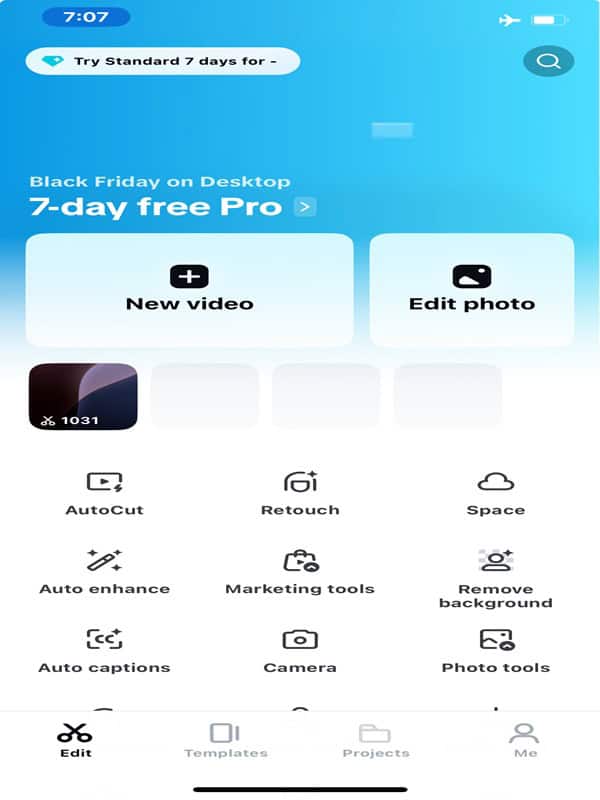
Step 1: Open a New Project
- Launch the CapCut app.
- On the home screen, tap “New Project“, it’s the large button usually at the top or center of the screen.
- Select the video clip you want to enhance from your phone’s gallery, then tap “Add” in the bottom-right corner.
Step 2: Go to Adjustments
- Once your clip loads into the timeline, tap the video clip on the timeline to bring up the bottom toolbar.
- Swipe through the toolbar from left to right until you find “Adjust” (the icon looks like sliders).
- Tap “Adjust” to open all the manual enhancement options.
Step 3: Manually Tweak the Settings
Inside the Adjust menu, you’ll see sliders for various image properties. Here’s what each does:
- Brightness: Fixes dark or underexposed scenes.
- Contrast: Adds sharper definition between light and dark areas.
- Saturation: Makes colors more vivid.
- Exposure: Lightens up shadows and mid-tones.
- Sharpen: Highlights edges and fine details for a crisper image.
After adjusting each slider, tap the checkmark (✔) at the bottom-right corner to apply the changes.
Step 4: Use the “Enhance” Feature (if available)
- Go back to the main toolbar below the preview screen.
- Scroll until you see “AI Tools” (it’s often located toward the right end of the toolbar).
- Tap “AI Tools” → “Enhance.”
- Toggle it on — CapCut will automatically clean up lighting, contrast, and clarity for a polished look.
(Note: If you don’t see “Enhance,” update CapCut to the latest version.)
Step 5: Add Filters and Effects
- Return to the bottom toolbar and tap “Filters.” It’s usually beside the “Effects” option.
- Browse through the filter categories such as Life, Food, Retro, or Cinematic.
- Tap on any filter to preview it on your video.
- Use the intensity slider (just above the toolbar) to control how strong the filter appears.
- Tap ✔ to confirm.
- For more creative touches, you can also go to “Effects” → “Video Effects” and add subtle enhancements like Glow, Lens Flare, or Blur.
Step 6: Set the Best Export Settings
- When you’re done editing, tap the “Export” button, it’s the upward arrow icon at the top-right corner of your screen.
- Before saving, check these settings that appear above the “Export” button:
- Resolution: Choose 1080p or 4K for high-quality playback.
- Frame rate: Select 30fps for standard videos or 60fps for smoother motion.
- Bitrate: Set to High for better clarity (though file size will increase).
- Tap “Export” again to save your enhanced video to your device.
The export settings that keep your video looking sharp (CapCut quality tips)
A lot of people “enhance” their clip… then ruin it at export. If your final video looks worse, it’s usually because the bitrate is too low or the resolution doesn’t match the original.
Best general export settings (safe for most videos)
- Resolution: 1080p (use 4K only if your original footage is 4K)
- Frame rate: match your original (usually 30fps or 60fps)
- Bitrate: choose High, or set a custom bitrate if CapCut allows it
- Format: MP4 (H.264) for the best balance of quality and upload compatibility
Platform tip (this matters)
TikTok, Instagram Reels, and YouTube Shorts will re-compress your video. That means you want a clean export with a strong bitrate so the platform has more detail to work with.
Quick rule: If your video has fast movement, text on screen, or lots of detail (hair, grass, patterns), export with the highest bitrate you can without crashing your phone or PC.
Will You Pay More to Improve Video Quality on CapCut?
CapCut lets you enhance your video quality without paying anything for most features.
You can adjust resolution, tweak brightness and contrast, apply filters, and even use color correction tools for free.
These built-in settings already help make your videos look sharper and more polished.
However, some features that push video quality even further are part of CapCut Pro. The paid version gives access to higher export resolutions like 4K, smoother rendering, and advanced enhancement tools powered by AI.
If you create content professionally or need studio-level quality, the Pro plan is worth considering.
But for everyday editing or social media clips, the free version is usually more than enough to improve video clarity.
If you’re trying to figure out whether the paid plan is worth it for quality features like higher export options and extra AI tools, see my full breakdown of CapCut pricing plans.
Expert Tips to Get the Best Quality Possible in CapCut
- Start with good footage. Even the best editor can’t fix extremely blurry or out-of-focus videos.
- Use natural light when filming. It reduces noise and gives you more to work with later.
- Don’t over-sharpen. It can make your video look grainy or fake.
- Match resolution and frame rate. Exporting in higher resolution than the source won’t add real detail.
- Avoid re-exporting multiple times. Each export can slightly reduce quality — always work from your original.
- Use the preview window at 100%. It helps you see true clarity before exporting.
Common mistakes that make CapCut exports look worse
- Over-sharpening: makes faces look rough and adds grain.
- Brightening too much: lifts noise and makes the clip look dirty.
- Exporting at low bitrate: causes blocky pixels and soft details.
- Changing frame rate at export: can create weird motion blur or jitter.
- Stacking heavy filters: can crush detail and make colors look fake.
Common Problems When Trying to Improve Video Quality
- The video looks blurry after exporting: You may have exported at a low bitrate or resolution. Re-export at higher quality settings.
- The colors look washed out: Adjust contrast and saturation manually or use a cinematic filter for more depth.
- The footage looks pixelated: Try using the AI Enhance feature before exporting. Pixelation usually happens when the source resolution is low.
- The app lags when enhancing: Close other apps or lower preview quality. High-quality rendering can be resource-heavy.
- The final video doesn’t look better than before: Remember, enhancement improves clarity and color, not resolution. Try balancing brightness and contrast instead of pushing resolution.
When to Use Other Tools Alongside CapCut
CapCut does a great job for social content TikToks, YouTube Shorts, Reels, and vlogs.
But if you’re working on larger projects (like cinematic videos or commercial work), you might want to pair it with other software:
- Use CapCut for initial cleanup (color, sharpness, stabilization).
- Then move to a pro editor like Premiere Pro or DaVinci Resolve for color grading or advanced upscaling.
CapCut is amazing for quick, impactful improvements — especially when your goal is to make social videos look crisp and professional fast.
FAQs
Can I improve video quality on CapCut automatically?
Yes. CapCut’s AI Enhance tool can clean up your clip fast by improving contrast and clarity. For the best results, still do a quick manual pass after: fix lighting first, then add a small amount of sharpness.
Why does my video look worse after exporting from CapCut?
Almost always it’s export settings. If the bitrate is low, details get blurred and blocky. Export at 1080p (or match your source), match the original frame rate, and choose High bitrate.
Does exporting 4K in CapCut improve quality if my clip is 720p or 1080p?
Not in a real-detail way. 4K export can look a bit cleaner on some screens, but it won’t add true detail that wasn’t captured. You’ll get a bigger improvement from lighting fixes, noise cleanup, and a high bitrate export.
How do I make a blurry video clearer in CapCut?
Start with lighting, not sharpness. Increase exposure/brightness slightly, add a touch of contrast, then apply a small sharpness boost. If the blur is from grain/noise (low light), reduce noise first so sharpening doesn’t make the clip look gritty.
How do I fix grainy or noisy videos in CapCut?
Use Denoise (if your version has it) or keep the clip from getting brighter than it needs to be. Grain usually gets worse when you push brightness too high or sharpen too hard.
Why does my CapCut preview look blurry but the exported video looks fine?
CapCut may lower preview quality to keep editing smooth. Judge quality based on the exported file, not the timeline preview. If your export is also blurry, raise bitrate and confirm you exported at 1080p+.
What are the best CapCut export settings for TikTok, Reels, and Shorts?
Use 1080p, match your original frame rate (30fps or 60fps), and choose High bitrate. Social apps compress videos, so starting with a clean export helps your video stay sharper after upload.
Will sharpening in CapCut make my video look worse?
It can if you push it too far. Over-sharpening brings out grain, makes skin look rough, and creates harsh edges. Use a small boost, then stop. If your clip is noisy, reduce noise first.
Can CapCut really “enhance” old or compressed videos?
Yes, but with limits. CapCut can improve clarity, lighting, and color, and sometimes make a compressed clip look cleaner. It can’t fully restore detail removed by heavy compression, but it can make the video look more watchable.
Final Thoughts
So yes, you can improve video quality on CapCut. Just don’t fall for the “export in 4K and hope for a miracle” move.
The biggest upgrades usually come from simple fixes: clean up the lighting, remove grain if the clip is noisy, add a little sharpness, then export with a high bitrate so CapCut doesn’t throw away your details.
If your footage is already decent, these tweaks can make it look seriously polished. And if your footage is rough, CapCut can still make it more watchable, just know there’s a limit if the original video is out of focus or heavily compressed.
Do the steps in the right order, keep your edits subtle, and your videos will look cleaner, sharper, and more professional every time.
If you want to make your improved videos repeat seamlessly, check out our guide on how to loop a video on CapCut
